
Particle Conversations
The first formal paper on particles talking to particles. Limits of Information Flow Between Classically Interacting Particles, with Miles Miller-Dickson, in Physical Review E.
Professor of Engineering · Brown University
Wireless & beyond
Communication and information theory applied to just about everything — which, it turns out, is a defensible research program and not only a character flaw.
Interaction is usually defined by what we can observe about outcomes: reactants move toward equilibrium, momentum and energy are conserved, elements of an organism signal each other chemically, mechanically, electrically. Frame those observations mathematically and the equations confer predictive power — which is the whole point of science. However, any interaction is a communication, and communication implies information exchange. So to a communication theorist trained in the physical sciences, one question is inescapable:
What are all these interacting elements saying to one another, how are they saying it, and can I join the conversation?
Latest
The first formal paper on particles talking to particles. Limits of Information Flow Between Classically Interacting Particles, with Miles Miller-Dickson, in Physical Review E.
Improvisation, ensemble, and standards — applied to how we bring students into science and engineering. Slides · MIT Equity Forum panel · MIT alum piece
Brown's presidential lecture series — deciphering mysteries of our world and beyond. Chaired since 2014.
Formal academic puffery, in PDF. See also the Wikipedia page, which is personal puffery.
Who
Chris received the S.B. (1979), S.M. (1981) and Ph.D. (1985) degrees, all from MIT. Following graduate school he joined AT&T Bell Laboratories in Holmdel, New Jersey, as a member of the Network Systems Research Department, where he regaled his peers with levitated-center-conductor high-Tc superconducting cables, annoyed them by showing that random lightwave network architectures perform about as well as carefully sculpted ones, and puzzled them with odd applications of cellular automata.
In 1990, when Arno Penzias told everyone in "Area 11" to go to academe if they weren't keenly interested in the corporate bottom line — including his Nobel partner Bob Wilson — Chris was congratulated on his timing, having joined Electrical & Computer Engineering at Rutgers the very next week.
He stayed at Rutgers until 2015, when he moved to Brown as Professor of Engineering and Associate Dean of the Faculty for Special Initiatives. In 2020 he was appointed Associate Provost for STEM Initiatives, and served as the inaugural Director of STEMJazz Programs until 2026. He is a Fellow of the IEEE, cited "for contributions to wireless communication systems theory," and served as a full member of the Army Science Board (2013–2014).
He was Associate Director of WINLAB (1999–2007). His current technical interests include applications of communication and information theory to just about everything: biology, nano- micro- and macro-mechanical systems, and — tantalizingly — maybe even supersymmetry, by way of Jim Gates' intriguing Adinkra formalism.
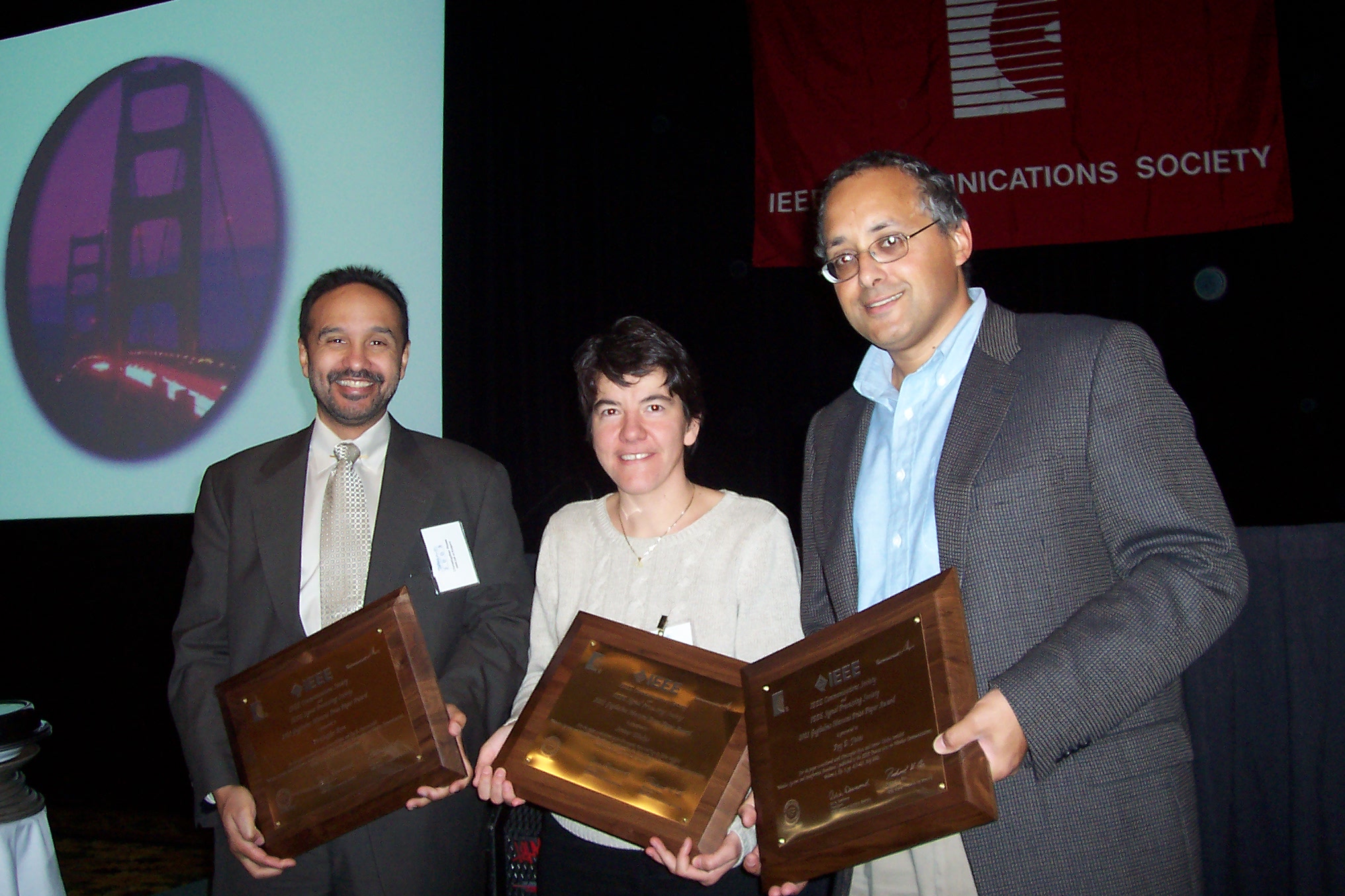
Past wireless interests include novel mobile communication networks, genetic algorithms applied to control problems in networks, and interference avoidance — universal radios negotiating peaceful coexistence in the wireless ecology of the 5 GHz U-NII bands. That work, with Sennur Ulukus and Roy Yates, received the 2003 IEEE Marconi Prize Paper Award in Wireless Communications. Here's a picture of the ecstatic authors at the Globecom 2004 ceremony (credit: Aylin Yener).
And for fun — as an outgrowth of research on opportunistic communications — he took on a problem everyone has wondered about at least once: how will first contact actually happen? The interesting twist is that it can be far more efficient for distant little green people to send information-bearing physical artifacts than electromagnetic signals, which is seemingly at odds with current SETI wisdom. That story is over here.
Research
Different systems, same move each time: treat the interaction as a channel, then ask what the channel can and cannot carry.
If two billiard balls collide, how many bits did they exchange? Conservation laws turn out to be the null space of the interaction channel. This is the current obsession.
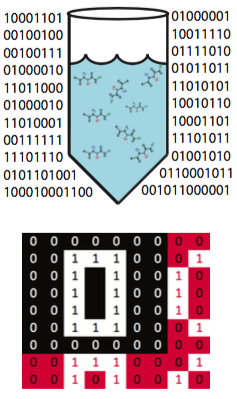
Follow the thread →What are the fundamental limits when your symbols are actual molecules — released, diffusing, arriving late and out of order? Timing, payload, and 40 bps using alcohol and a photoionization detector.
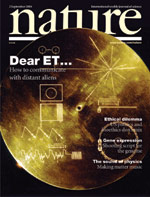
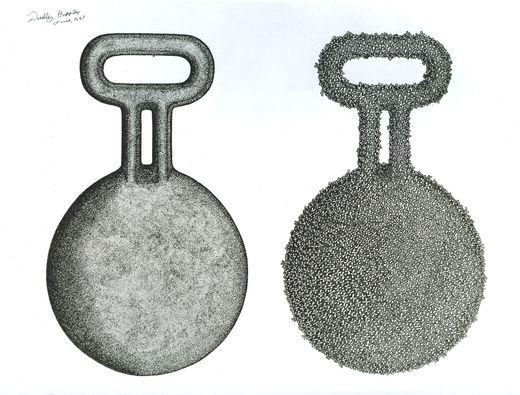
Follow the thread →Sending inscribed matter beats radiating photons across interstellar distances, by a lot. Nature cover, September 2004 — plus an astounding amount of press, a NY Times editorial, and a cartoon competition.
Follow the thread →Organization emerges and repeats despite everything the world throws at biological systems. What is the code-to-structure transformation, and does it have coding theorems?
Follow the thread →Radios that adapt their codewords until everyone can hear. Class warfare, water filling, and the U-NII bands. Marconi Prize Paper, 2003.
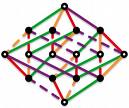
Follow the thread →Jim Gates' graphs encode supersymmetry algebras — and look suspiciously like error-correcting codes. Somewhere between profound and ludicrous, which is the fun part.
Follow the thread →Teaching
A long-running experiment in undergraduate education, conducted with insufficient controls and reported here with full transparency about the confounds.
Beer + Pizza = Academic Excellence
Proof: three Rutgers EGC Teaching Excellence Awards. ∎
Beer + Pizza + BBQ = Universal Academic Excellence
Proof: 2011 EGC Best Teacher in Engineering Award. ∎
Odds & ends