Nature 431, pp. 47–49 · 2 September 2004
Cosmic
Communications
Write, don't radiate
How will first contact happen — by radio, or by artifact? Strangely enough, we think artifacts are more likely.It is often many, many orders of magnitude cheaper, in energy, to write a message down in some medium and literally throw it at the recipient than to radiate it electromagnetically — provided you can tolerate delay beyond light transit time. So perhaps SETI should be sifting through dust, pebbles and rocks as well as sweeping the spectrum.

Nature's cover blurb
What the editors made of it
It's almost a given that remote civilizations will try to contact us using radio waves. The search for extraterrestrial intelligence was first mooted by Giuseppe Cocconi and Philip Morrison 45 years ago, and since then two million years of CPU time has been given to SETI@home in the spirit of that paper: the probability of success is difficult to estimate, but if we never search, the chance of success is zero. Christopher Rose and Gregory Wright propose a new take. It seems the "Sounds of Earth" gold disks aboard Voyagers 1 and 2 were on the right track. The message-in-a-bottle idea of sending physical objects across space is highly energy efficient, and we should search for artefacts in the Solar System now.
If that blurb made little sense, some very good science writers put it better — see the press coverage. A few even managed to drag the right words out of me during radio interviews, at least where they could contain my digressions and technospeak.
The argument
Why matter wins
This work was an accidental outgrowth of research on terrestrial wireless. It is careful about the energetics, and it deliberately stacks the deck in favour of radiation — assuming things like infinite bandwidth — before deriving outer bounds on the ratio of energy needed to deliver a message by inscribed matter versus by radiation.
We worry about directed radiation, aperture sizes, and the fact that there are many targets to reach. Matter transmission still wins.

Later versions added the delivery problem (how do you slow the particle down at the destination?), the construction problem (how much energy to build the particle in the first place?), and a version of the civilization communication problem — civilizations are almost certainly asynchronous, whether through celestial calamity like meteor strikes or through competition and stupidity. We had wanted to hold these back, but various referees felt they were necessary to convince readers that evidence of ET might turn up in grains of sand, or on comets and meteors.
We also considered the ballistic aiming problem, since gravitational perturbations might knock a package off course. The effect seems small.
Of course, if energy is no object — consider Freeman Dyson's sun-herding, or building what amounts to a giant blinker around a star — our energy comparisons are irrelevant. But since such feats are not presently on our technical horizon, we are biased toward worrying about energy.
Quantitative analogies
How big is "many orders of magnitude"?
The numbers are the fun part, and they are genuinely hard to hold in your head. Here are four attempts to make them physical.
Lift a sack of sugar, or detonate 27 megatons?
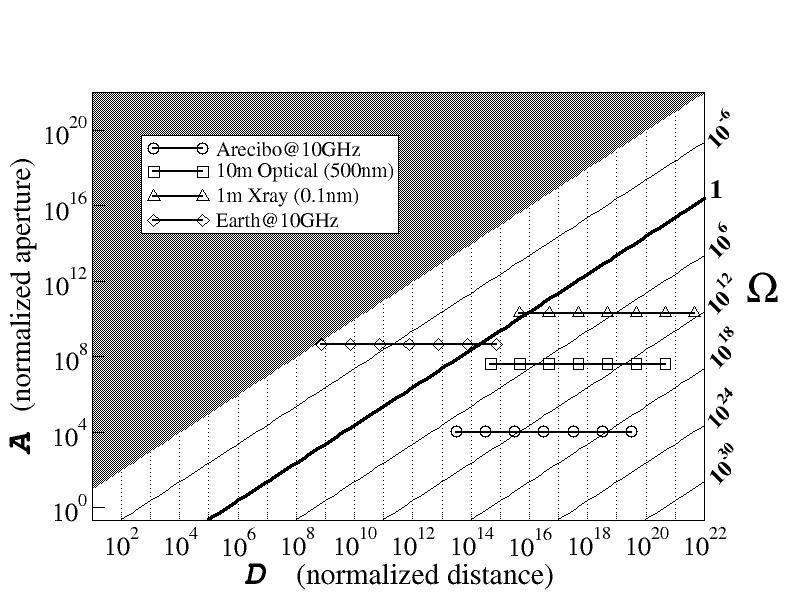
Take an Arecibo-to-Arecibo radio link over ten thousand light years, at a delivery speed of c/1000, with no shielding costs charged to the matter. The efficiency gain of inscribed matter (at ρ = 1023 bits/kg) over radiation is about 5.7 × 10¹⁶.
So if the energy to deliver the matter were equivalent to raising a two-kilogram bag of sugar one metre off the ground, the energy needed to radiate the same message would be a 27 megaton nuclear blast.
You'd need a galaxy ten times bigger than the visible universe before radiation wins
Radiation looks like it should have an advantage: it covers more targets at once. But to be even remotely competitive, the radiation must be collimated — and the tighter the collimation, the fewer star systems get illuminated. That requirement vitiates the broadcast advantage entirely.
Put it the other way round: send isotropically into a spherical galaxy of uniform stellar density, and charge matter the full cost of a shielded package to every single star in the volume. The breakeven galaxy — where there are finally enough stars that radiation becomes more efficient — is about ten times larger than the visible universe.
How long is long?
Because of shielding, the argument favours long messages over short "we exist" pings. Stefan Lovgren of National Geographic sensibly asked exactly how long "long" is.
For the Arecibo example at ten thousand light years, inscribed matter beats radiation for messages larger than about 1014 bits — roughly the written information in the Library of Congress.
How well can we aim?
For grossly macroscopic particles, Heisenberg is irrelevant. What matters is random gravitational perturbation en route, from the pull of stars whose placement we don't precisely know. It turns out aiming is relatively unimportant.
Mass information density
Bits per kilogram, from Voyager to lithium
The whole argument turns on ρ, how many bits you can pack into a kilogram. The span from a gold phonograph record to a protein is nineteen orders of magnitude — which is why the conclusion is so lopsided.
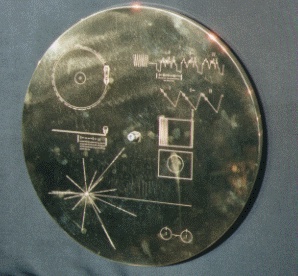
- Voyager gold record106 bits/kg
- Laser-printed paper, 1000 dpi1010 bits/kg
- DVDs3 × 1012 bits/kg
- A 60 GB laptop disk, whole6 × 1012 bits/kg
- DVDs, if you could laminate 1 µm layers3 × 1015 bits/kg
- Magnetic film only, laptop disk1017 bits/kg
- 0.1 µm SiO2 lithography1018 bits/kg
- AFM "fountain pen," 40 nm dots4.8 × 1019 bits/kg
- SiO2 e-beam lithography1021 bits/kg
- DNA1.8 × 1024 bits/kg
- Single-stranded RNA3.6 × 1024 bits/kg
- Proteins2.3 × 1025 bits/kg
- Lithium + beryllium7.5 × 1025 bits/kg
For comparison, some payload sizes
Mostly lifted from Michael Lesk's now rather quaint 1997 paper.
- 20 TBBooks in the Library of Congress1.6 × 1014 bits
- 2000 TBPictures and everything else in the LoC1.6 × 1016 bits
- 4000 PBEvery telephone call for a year3.2 × 1019 bits
- —One human genome6.4 × 109 bits
- —Every human genome on Earth4 × 1019 bits
- ?The Earth ecosystem genomeNobody knows.
Cartoons
Students illustrate the idea
We ran a cartoon competition. Caroline Angelo took first place with a drawing that put together every element of a message hurled from very far away; Zhen Li and Xiangpeng Jing took second and third with animated GIFs. There are honourable mentions, an anonymous entry that was artistically my favourite but got the distances wrong, and a cut-to-the-chase effort from Dick Frenkiel — a conceptual genius, and about as good an artist as I am.

Some captioned pictures people have found especially amusing, and a hilarious application of the idea from the Annals of Improbable Research — the opening illustration is priceless. Saul Perlmutter brought that one to my attention; he obviously has a cosmic sense of humour, which probably had some hand in discovering that the universe is expanding faster and faster.
Coverage
Commentary, press and radio
An astounding amount of it, including a New York Times editorial. Local copies are kept for everything, because link rot is real and most of these are twenty years old.
Newspapers
- New York Times — article by Dennis Overbye, 2 Sep 2004
- New York Times — editorial, 8 Sep 2004
- NJ Star Ledger — front page by Kevin Coughlin
- Philadelphia Inquirer — article by Dawn Fallik
- Telegraph — article by Roger Highfield
- The Times of India — article
- Howard Scripps — article by Lee Bowman
Magazines & journals
- Nature — cover blurb
- Nature — News & Views by Woody Sullivan
- Nature News — article by Mark Peplow
- news@nature — article by Philip Ball
- Scientific American — SETI: Check the "In" Box by Charles Choi, Nov 2004
- National Geographic — article by Stefan Lovgren
- New Scientist — article by Jenny Hogan
- Astronomy — Would ET Phone or Write? by Dan Falk
Broadcast & online
- BBC — article by David Whitehouse
- CNN — article by Robert Britt
- ABC News — article by Amanda Onion
- MSNBC — coverage
- Discovery Channel — article
- Space.com — article by Seth Shostak
- NSF Discoveries — feature, 10 Mar 2006
- Science a GoGo — on comets Tempel-1 and Wild-2
Radio — listen
- NPR, All Things Considered — with David Kestenbaum, 1 Sep 2004
- BBC Radio 4, Leading Edge — with Geoff Watts, 2 Sep 2004
- BBC World Service, Science in Action — with Dee Palmer, 3 Sep 2004 (interview at 16:30)
- NPR, Science Friday — live, with Ira Flatow, 3 Sep 2004
- NPR/WBUR, Here and Now — with Gail Harris, 7 Sep 2004
- CBC, Quirks & Quarks — with Bob McDonald, 11 Sep 2004
- SETI Institute, Are We Alone? — live, with Seth Shostak, 26 Sep 2004
- Are We Alone? — Space Archaeology, 6 Jun 2011 (at 23:18)
Institutional
- Rutgers press release
- Rutgers Focus and Daily Targum
- Rutgers Ozma at 50 workshop
Publications & talks
Where this was argued out loud
- 2016Breakthrough DiscussStanford University, 15 April.
- 2013Communication Theory WorkshopPhuket, Thailand, 24 June.
- 2012Northern NJ Junior Science and Humanities Symposium19 March.
- 2011CSEE Seminar, UMBC9 December.
- 2011Lunch Bunch Seminar, Caltech25 October.
- 2006iCORE Summit keynote23 May.
- 2006British Interplanetary SocietySpace Archaeology Conference, 10 May. Programme.
- 2006Princeton ISS Seminar Series9 March.
- 2005Lawrence Berkeley National LaboratoryWorld Year of Physics lecture, 25 July. Abstract, poster, and Saira Mian's rather fun advertisement.
- 2005UT AustinGM Wireless Networking and Communications Seminar, 25 Feb.
- 2005UT San AntonioEE seminar, 24 Feb.
- 2004Telcordia Midnight Seminar Series16 December.
- 2004Asilomar9 November. Paper.
- 2004Nature letter2 September. Supplementary information.
- 2004DIMACS Workshop on Storage24 March.
- 2003Crawford Hill Coffee Hour21 October.
- 2003VTC Fall8 October. Paper.
Earlier drafts, including the kitchen-sink versions
- LongWrite or Radiate: inscribed mass vs. electromagnetic channelsThe long version of the conference paper.
- DraftAn earlier draftWith comparisons using fossil fuels in the conclusion.
- DraftA streamlined versionWith Greg Wright. Added E. coli transcription energetics, for fun.
Musings
Where the idea leads if you let it
Cosmically selfish genes
If civilizations at any given stellar location are short-lived — through celestial or geological calamity, or self-inflicted — there could be a survival benefit to seeding the cosmos with compelling records of a civilization, in the hope of eventual adoption by fledgling civilizations or absorption by older ones.
But under the assumption of impermanence, literal biological seeding of likely habitats — Crick's panspermia — seems much more likely, because it confers a selective advantage of sorts. Civilizations that seed may survive in some form; those that don't may perish completely.
I have a soft spot for comets as delivery vehicles. They release material during transit through the inner solar system and they are highly visible. The annoying fact is that their orbits are stable only for tens of thousands of years rather than hundreds of millions, which doesn't leave local denizens much time to acquire the technology to reach out and grab one. For biological seeding, though, comets look decent. More on this.
Is life the message?
Michael Crichton made exactly this point — that life might be the message, and explicitly that it is more efficient to send a package than to radiate — in his 1969 novel The Andromeda Strain, pp. 222–225. Courtesy of Rich Howard.
Of motes and matter
One admittedly crazy image I cannot shake: arrays of computer chips using MEMS catapults to move information instead of optical or electromagnetic bus lines. Eventually I nagged myself into doing the calculation. Wafer-to-wafer communication over 10 cm at about 0.3 m/s, against infrared laser communication with 5 µm apertures.
The matter efficiency comes out at Ω = 5.2 × 10⁻¹⁴ρ. So tossing little magnetic chits back and forth would be roughly 5000 times more energy-efficient than laser communication — and if an STM tip inscribed the surface of an SiO2 chit, more than a thousand times better still. Smart dust tossing inscribed dust may not be so crazy after all.
There's one born every minute
New Scientist once profiled a now-defunct service — racket — whereby you called a 900 number to leave voice messages for ET, to be beamed into space with a satellite dish. They contacted me, and since silence can imply complicity, I did the calculation. I suspect customers had little hope of getting their messages across. But people bought pet rocks in the '70s, so perhaps there were plenty of takers.
Credit where credit is due
Thank you
A special note of thanks to Leslie Sage and the editorial staff of Nature, who saw something of interest in an overlong and overmathy draft and shepherded a newbie through the process from presubmission enquiry to final paper. I would have thanked Leslie formally in the acknowledgements — he made substantive contributions; the Voyager comparison was his idea — but it seemed to go against Nature's policy. This was the most enjoyable editorial experience I have ever had, and it would have been even if the paper hadn't made the cut. Bravo Nature, and a special bravo Leslie.
Without countless invaluable conversations with G.J. Foschini, or N. Beaulieu's eye for potential and strong encouragement, I would never have approached Nature with this work. Thank you both.
Two misprints in the published acknowledgements to correct: special thanks are due to Paul Henry for being an invaluable sounding board early on, and to Stavros Toumpis for careful reading of an early manuscript. Their names were mangled in the paper, so they get capitals here.
A common question: how did an independent consultant-astronomer and a professor of wireless communications theory find each other? We're both part of the post-divestiture diaspora from the old Crawford Hill lab at Bell Labs Research — of Telstar and big-bang background radiation fame.
Tripped over a broken link? Please email me. No guarantees, but I'll try to get to it.