Research
Six threads
One question, applied repeatedly
Take a system. Notice that its parts are interacting. Insist that the interaction is a channel. Ask what that channel can carry, and at what cost. Then see what falls out — sometimes a capacity bound, sometimes a conservation law, occasionally an argument about aliens.
It from channel
Talking particles
Two objects collide. Momentum and energy are conserved. Standard physics stops there — but from a communication standpoint something else just happened: each particle learned something about the other. How much? In bits?
It turns out you can ask that question precisely, and the answers are not trivial. Conservation laws look like the null space of the interaction channel: the directions in which no information flows. Mass ratios control how much gets through. And there are regimes where a cascade of collisions conspires to reveal almost nothing at all.
This is the thread that ties everything else on this page together, and the one currently eating most of my attention.
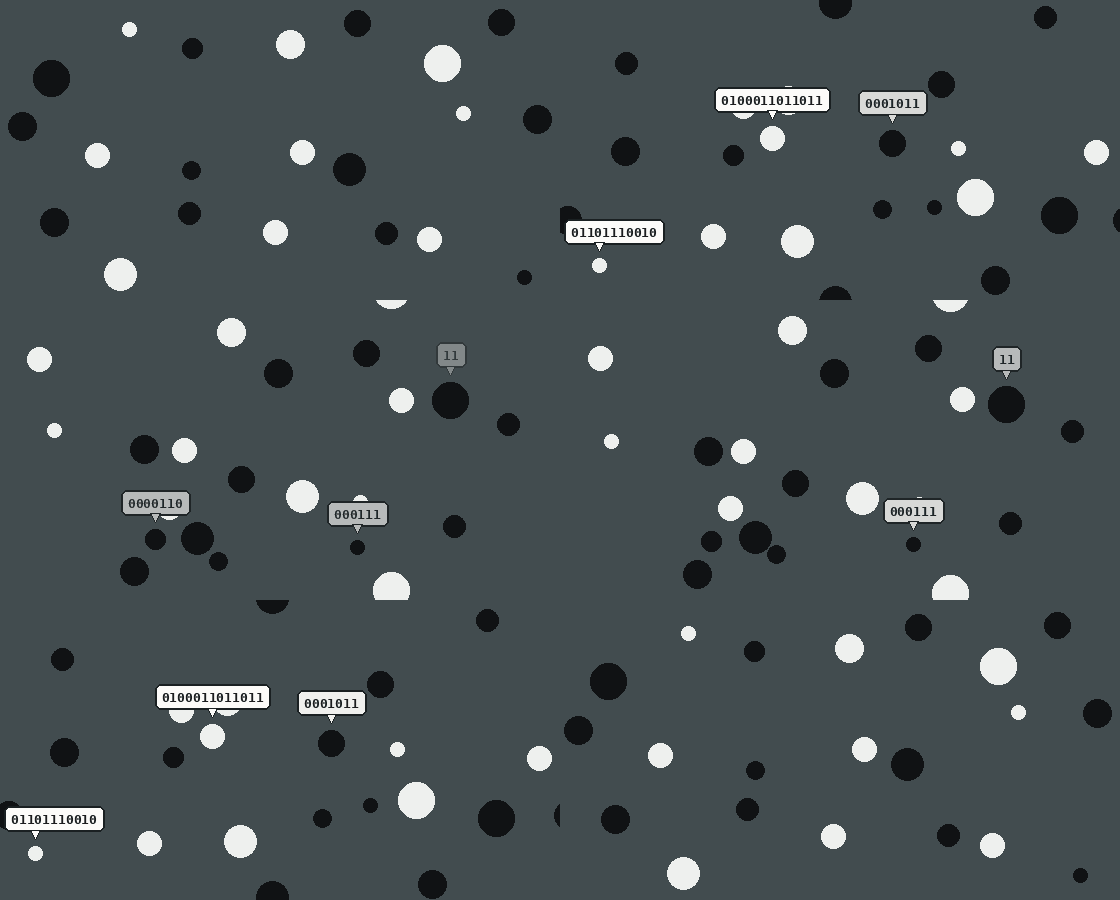
- 2026 Limits of Information Flow Between Classically Interacting Particles Physical Review E, with Miles Miller-Dickson. The first formal paper on particles talking to particles.
- ISIT '16 State Estimation, Wireless Tropes, Demons and Uncertainty A crazy paper that was allowed to sneak in. Talk slides.
- ITA '13 A fun talk Where the whole "communication conquers the universe" idea got aired in public for the first time.
Molecular
Communicating with molecules
Suppose your symbols are not voltages but actual molecules: released into a fluid, diffusing, arriving late, arriving out of order, sometimes not arriving at all. What is the capacity of that channel?
The honest answer required rebuilding a fair bit of the theory from scratch — timing channels with multiple identical quanta, energy constraints, the interplay of timing and payload — and then, with collaborators at Brown, actually building the things. We have run 40 bits per second through open air using rubbing alcohol and a photoionization detector, and stored information in mixtures of small molecules.
The DARPA Molecular Informatics work lives at molecularcomputing.info.
- Proc IEEE Capacity Bounds on Point-to-Point Communication Using Molecules 2019. The closest thing to a summary of the whole program.
- Compendia Inscribed Matter Communication Part I and Part II Magnum compendiums that no one might ever read. IEEE TMBMC, 2016.
- ISIT '19 A General Upper Bound on Particle Timing Channel Capacity Under constant particle emission intensity.
- Globecom 40 bps using alcohol and photoionization detectors 2018. It works.
- Video NSF Molecular Communication Workshop talk 2020. All workshop videos.
SETI
Write, don't radiate
How will first contact with an extraterrestrial civilization actually happen? The conventional answer is radio. The interesting twist is that it can be far more efficient for distant little green people to send information-bearing physical artifacts than electromagnetic signals — seemingly at odds with current SETI wisdom.
Inscribed matter wins because photons spread and matter does not. Do the energy accounting per bit delivered and the conclusion is hard to escape. This was the cover of Nature on 2 September 2004, with Gregory Wright, and it drew an astounding amount of press including a New York Times editorial. It also appears in Stephen Webb's If the Universe Is Teeming with Aliens… Where Is Everybody? as reason #35 of 75.
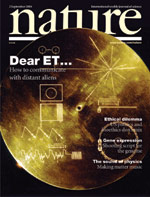
- Paper Inscribed Matter as an Efficient Means of Communication Nature letter, plus supplementary information.
- Press The complete coverage archive NY Times (news and editorial), Star Ledger front page, BBC, NPR, CBC, Scientific American, CNN.
- Fun The cartoon competition Yes, there was a cartoon competition. Caroline Angelo took first place; the winning entries are all still there.
- Talk Write, Don't Radiate Breakthrough Discuss, Stanford, 2016.
- Practice The Lunar Library, 2019 Someone actually did it. My sidebar.
- Also The NSF Discoveries feature and Project OZMA at 50 NSF ran the story on 10 March 2006 — the work was supported in part by the National Science Foundation, and the acknowledgement is in the Nature letter. Their own copy is long gone, so this is the local one. OZMA at 50 is where I ended up on a panel in Green Bank, West Virginia.
Biology
Cells, signals, and shape
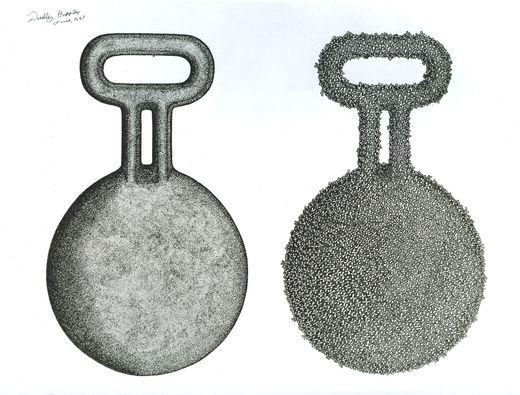
After submitting a proposal on communication theory in biological systems to the NSF CDI competition, I stumbled across a drawing at the Museum of Modern Art in New York. The title is Art and Nature; the artist is Dudley Huppler.
My interpretation: science is crisp and neat. Nature is messy, composed of myriad inter-communicating actors. Yet organization not only emerges but is uncannily repeatable, despite the plethora of insults hurled at biological systems by the world. The nature of that implicit, reliable code-to-structure-and-function transformation is one of the big questions in biology. (The ever-popular "are we alone?" is another one.)
My partner in crime here is Saira Mian, a broadly knowledgeable computational biologist at Lawrence Berkeley National Lab. The hope is that there are coding, channel, network and rate-distortion theorems in there somewhere — perhaps even transcending biology, since at heart everything is a network of inter-communicating actors.
What captivated me a few years back was Mina Bissell's work on tissue architecture and cancer. Genotypically malignant cells that stay quiet in normal tissue somehow know when they reside in a normal architecture and when they do not. If that isn't a communication problem, nothing is.
- Proposal The NSF CDI proposal, and the reviews Funded, 1 September 2008. Thank you, panelists, whoever you are.
- Paper Communication Theory and Multicellular Biology Integrative Biology 3, 2011.
- Reading Life, Logic and Information Paul Nurse in Nature "Horizons." The gist: we need to understand information flow in biological systems. Which is the point, though we are rather more literal about it.
- Quote "Living things are so beautiful and precise that there must be a mathematics that describes them. Information theory is that mathematics." Tom Schneider, NIH.
Wireless
Sorta standard wireless research
Before everything became about particles and molecules, there were two decades of work on how radios should behave when they have to share.
Interference avoidance is the idea that radios can iteratively adapt their own codewords — greedily, selfishly, with no central authority — and still converge to a jointly optimal allocation. It works, it converges, and the convergence argument goes by the name "class warfare." That paper, with Sennur Ulukus and Roy Yates, won the 2003 IEEE Marconi Prize Paper Award.
Opportunistic communications — infostations — is the observation that if you are patient, you can wait to be near a base station and get your bits far more cheaply than if you insist on connectivity everywhere, always.
- Overview The interference avoidance paper storm Start here. Or go straight to the main paper.
- Overview Opportunistic communications Patience has its rewards.
- DySPAN Genetic Algorithms and Spectrum Sharing 2005.
- Policy FCC Technological Advisory Council briefing Interference avoidance, infostations and economics, 18 September 2002.
- Slides Spectrum server · Contentious spectrum management · Cognitive radio See also Roy Yates' page.
Supersymmetry
Adinkras
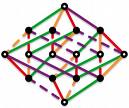
Jim Gates' Adinkras are graphs — black and white nodes, coloured edges — that encode supersymmetry algebras. They also look suspiciously like error-correcting codes, which is either a deep fact about the universe or a coincidence that has been leading people on for twenty years.
I have a summary slide that ties these threads together, from biology up to fundamental descriptions of the universe. It lies somewhere between profound and ludicrous, but it is so much fun that I keep showing it anyway. Post-talk comments make me think it is time to write the summary paper and incite the roiling masses of young communication theorists.
Musing
Everything in the light of day
Since about 2003 — starting with an unanswered letter to William Safire and continuing with an extremely weak talk I gave at Google in 2006 — I have been toying with the implications of the fact that soon everything will be recorded and very little will be private.
A small example. A candid photo of me was taken in Brazil at MWCN'01. I had no idea it existed until a Google search on my name turned it up. Now imagine zillions of such moments, audio included, uploaded wirelessly, correlated, indexed and searched by some Super-Google.
Assuming symmetry of access and information accountability, I am not sure that loss of public privacy is such a bad thing. It does give one pause that every public — and many an ostensibly private — moment could be subject to scrutiny. But I see this less as Big Brother and more as everything in the light of day, where the watched can watch the watchers. Steve Mann coined the rather good term sousveillance for it.
Update, Fall 2016: I have discovered Black Mirror. See season 1, episode 3. And then see season 2, episode 1, and imagine merging the two storylines.