Rose Bean Simpson
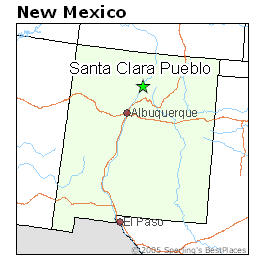
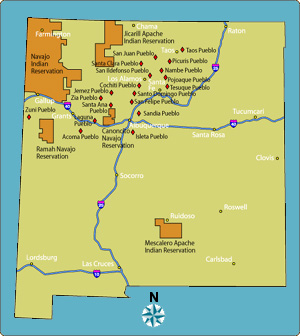
Rose from Santa Clara
Ceramics were a part of Rose’s life from childhood. Most of the women in her family, including her mother, are potters or ceramic sculptors. One of her aunts sells her black burnished pots for $30,000, and her grandma is both an anthropologist and a potter. Rose said that when she was a kid she thought everybody’s mom made pots and was shocked when she found out that other kids’ moms worked at restaurants or offices. Rose said that traditionally, each member of the pueblo was given a specific role to play. Some people were hunters or farmers, and some were potters.
Pottery has played a large role in the current economic divide within the Santa Clara community. The pueblo was traditionally divided into two moieties, the summer people and the winter people. Each governed for half the year and was assigned to separate tasks. The summer people were in charge of farming and summer hunting, among other tasks, while one of the tasks of the winter people was making pottery. As the popularity of Santa Clara pottery grew among visitors, the winter people became much wealthier than the summer people. Rose says there is still a divide in the community. The people who have been able to market their pottery to tourists have big houses and nice cars, while the others do not.
Pottery is integral to the Santa Clara conception of the universe. The traditional view of the world is one of nested bowls. The pueblo is one bowl, and at its heart is the kiva, a round, subterranean, ceremonial space. Next to it is a pot considered to be the center of the world. The bowl of the pueblo is set into the larger bowl of the surrounding fields, which in turn is surrounded by an even larger bowl represented by the foothills. The largest bowl is represented by the mountains. The sky is a basket set on top of the nesting bowls, and the stars are holes in the basket. Rose also told us a myth about a woman who was impregnated by a clay bed. She gave birth to a pot who was also a little boy. The boy-pot’s grandpa would carry him under his arm when he went hunting. One day they were on top of a hill and the little boy-pot begged his grandpa to roll him down the hill. The grandpa did so, and the pot rolled down the hill and smashed on the rocks at the bottom. Though the pot was broken, a little boy was there in its place. Santa Clara was a matriarchal society, and though most of the potters were women, there are also some male potters.
Traditional pottery techniques
Rose's mom sometimes sends her clay from Santa Clara to work with. It's a very micaceous clay, and they get it from a nearby clay source - it's within walking distance, but they usually take a truck to bring it back; she remembers being assigned, along with her cousins, to stomp on the clay on her grandmother's porch to work it to the point where her grandmother could wedge and work with it. Traditionally, most of the pots they make are/were functional pottery, and they would add grog to make it stronger and more heat-resistant; Rose and her cousins would also make little pots to sell at the roadside to tourists. While Rose sometimes uses a swivel to spin the pot while smoothing it out with a smoothing tool (see below), Santa Clara pots are traditionally coiled (though many of her relatives, now famous artists, sometimes throw their pots).
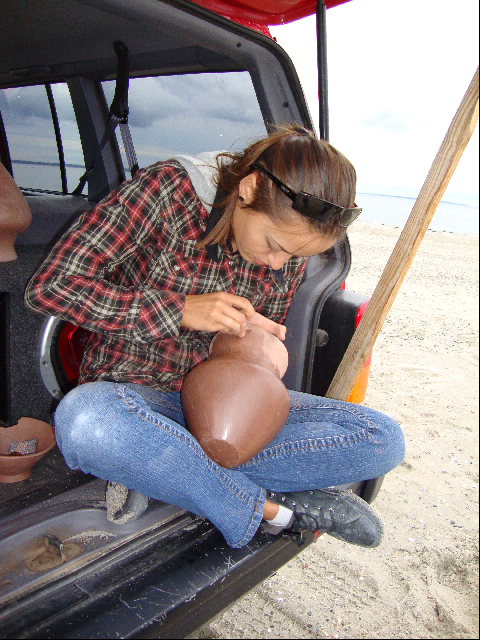
Rose at work at the RISD firing
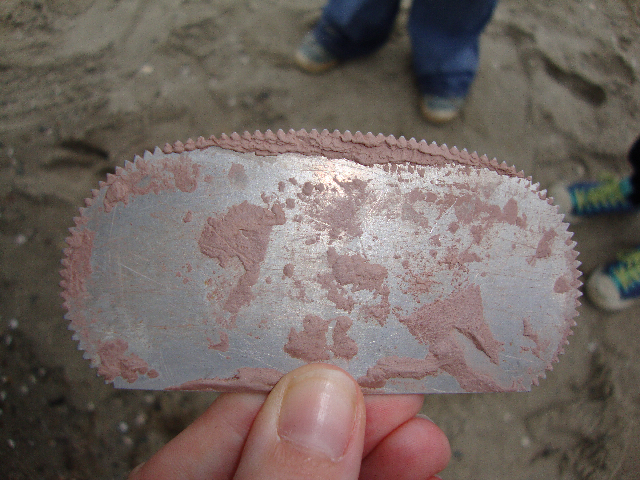
smoothing tool for coiled pots - traditionally, the potters from Santa Clara would have used pieces of gourd for smoothing.
Santa Clara pots are famous for their black burnished look - this is not actually how their pots would have looked traditionally, but became famous with the arrival of Fred Harvey and his assignation of designs to make their pots more marketable. To burnish, Rose uses smooth, polished stones (and a little bit of spit!) - sometimes they are passed down as family heirlooms, but she just bought the ones pictured below. This burnishing actually makes the pots less functional - the black one posted below, Rose says, would probably disintegrate in water. They are pit-fired (like many of us saw at the RISD farm) in a reducing atmosphere - smothered with cow pies at the end - to get the black color. Rose's aunt, Jody Naranjo, who sells pots for up to $30,000, is very careful about it because even one little spot of red lowers the price of the pot.
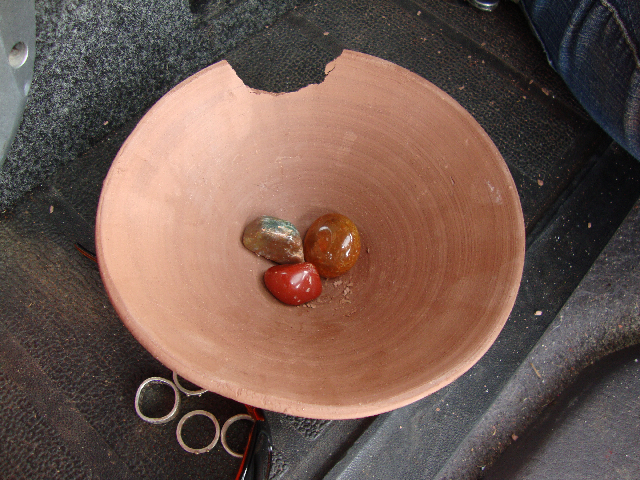
Rose uses smooth, polished stones (and some spit!) for burnishing the pots.
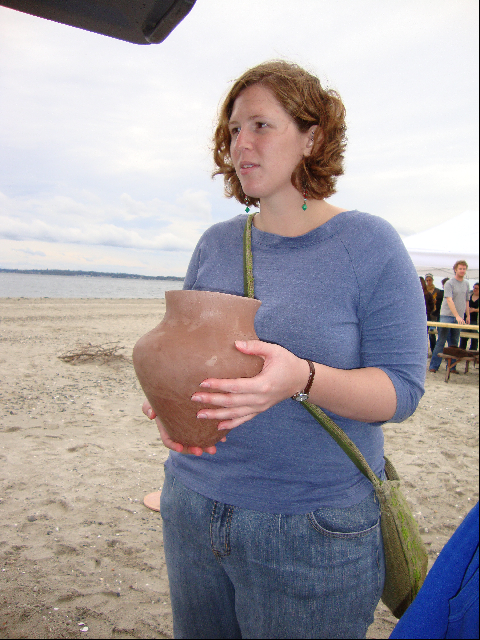
Katherine with the pot Rose was working on at the RISD firing
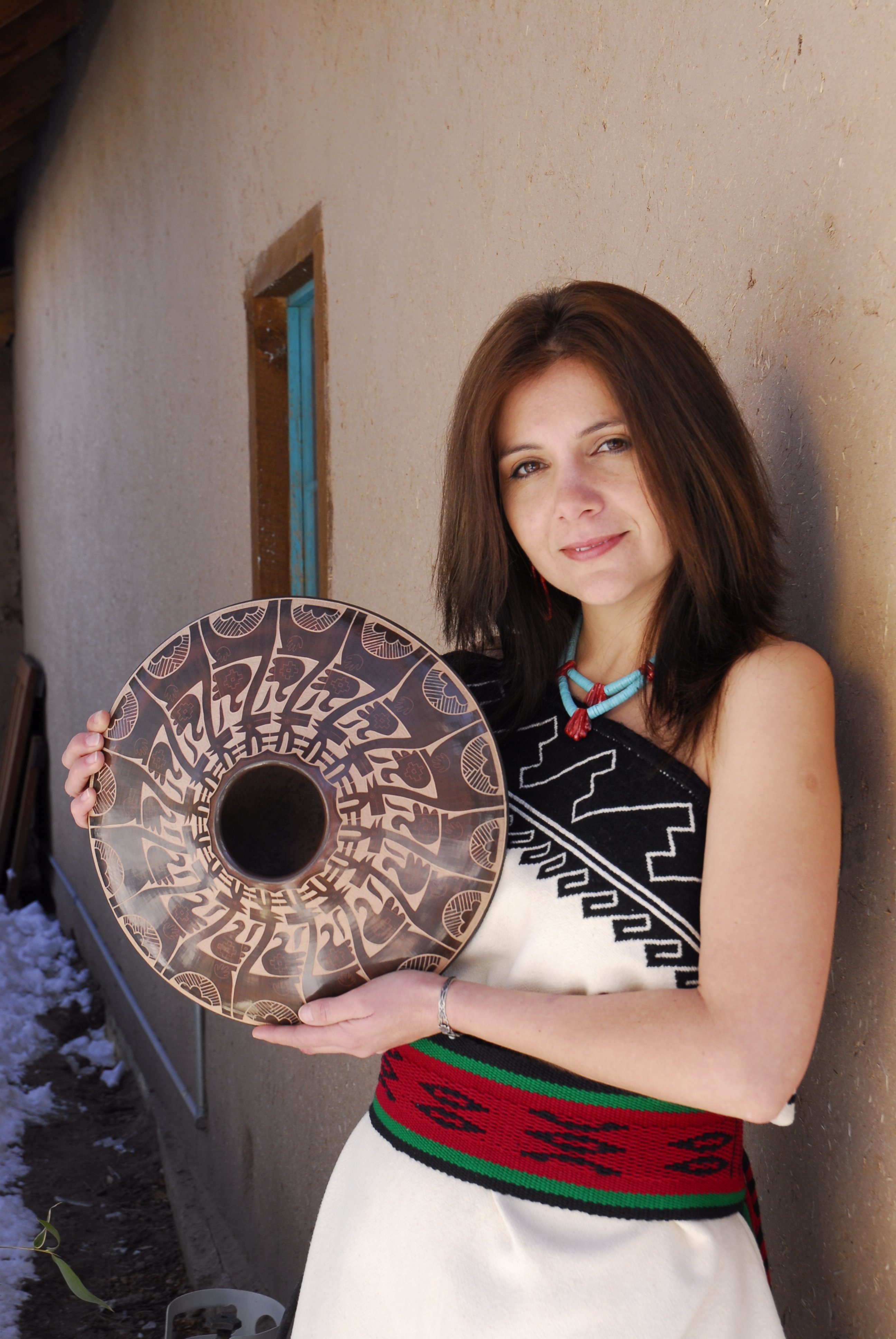
Rose's aunt, Jody Naranjo, a famous potter from Santa Clara; she still uses her grandmother's polishing stone.
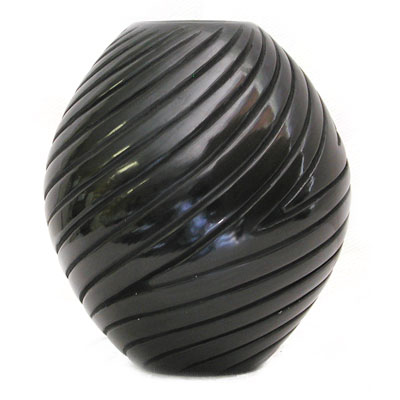
Santa Clara Pueblo's famous burnished black pottery
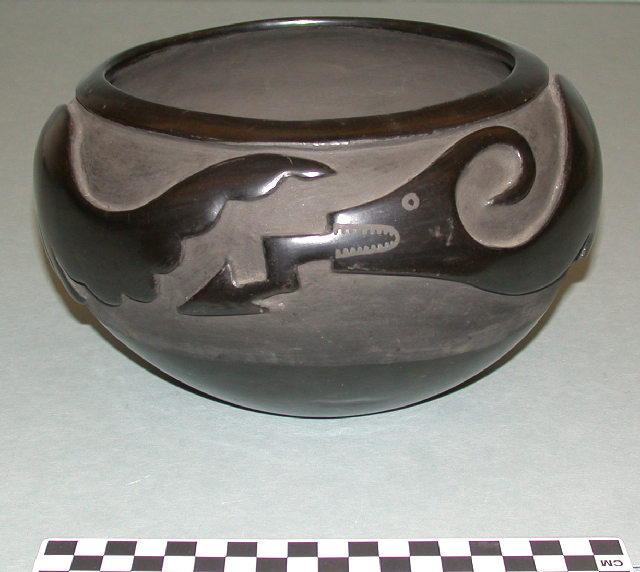
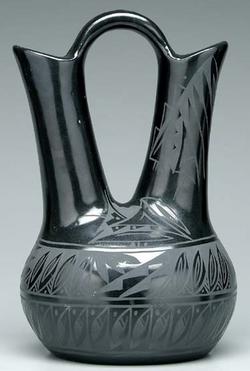
There are actually a lot of inconsistencies between the traditional pottery made by Santa Clara Pueblo and what is marketed today as such. Fred Harvey introduced many themes - like the deep etching on the bowl below, and the awanyu (serpent figure) - that were adopted by the Pueblo potters. Other influences have worked their way into what some, even members of the Pueblo, believe to be part of their heritage. One example is the wedding vase, pictured below; it was actually adopted in the last 100 years or so when there were many Jewish settlers living in the area, and the Pueblo adopted the tradition of breaking a vessel at wedding ceremonies. For this reason the Santa Clara Pueblo emblem, also pictured below, contains only one (real) traditional Santa Clara symbol: the bear paw on the wedding vase.

Rose's personal work:
While Rose works in ceramic sculpture (as well as being a poet and a musician), she says that growing up making pottery has totally informed her work - she coils many of her sculptures, large and small (like the ones featured on her website, or the one Katherine is holding in Rose's studio), and finishes and burnishes them much like pots. Though she is trying to push her boundaries, she says not closing an object is really difficult for her - it feels wrong, almost. When you are raised in a tradition that feels the world is like nested bowls, that makes a lot of sense.
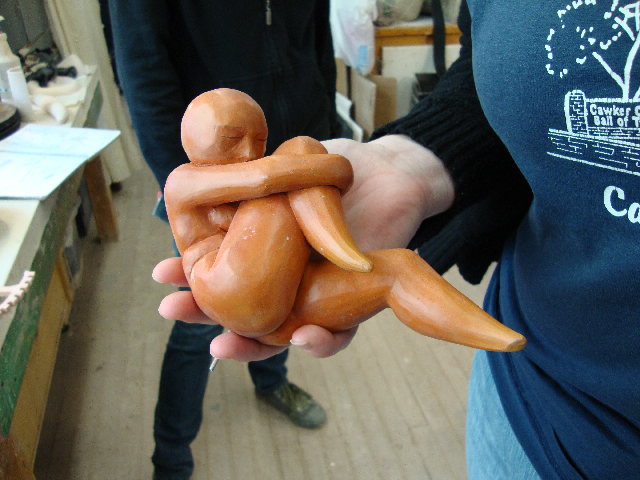
one of Rose's coiled figurines
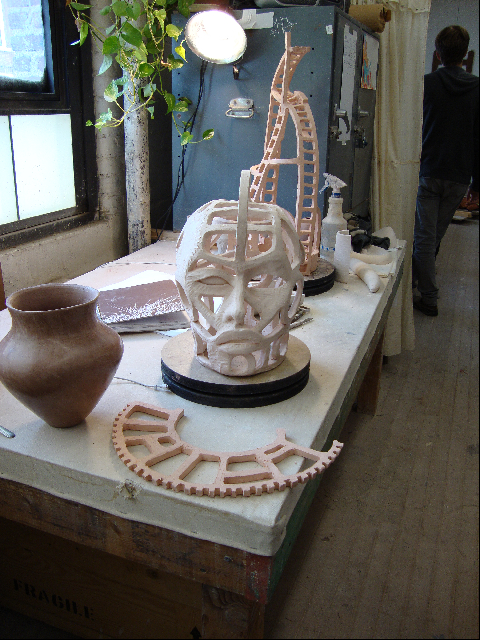
Rose is trying to push her boundaries by making more open sculptures
see more of Rose's ceramic sculptures
read more about Rose in American Indian Magazine:  "Rose Bean Simpson: 3-D Poet" (Fall 2009: 14-19) or at her website
