Interview with Brown Undergraduate Sara Hoffman, '11 by Emily Russo and Katherine Davis
Who is she?
Sara Hoffman, an education major at Brown, has been making pottery for two years. She first tried her hand at making pottery as a child, but she decided that she hated it due to its difficulty. Then, about two years ago, she took a class on pottery, enjoyed the experience, and decided to pursue it on her own. She is mostly self-taught and says she is constantly learning new techniques and methods through trial and error and from her own peers. Last year, she and several other Brown potters had a clay studio, a space which they have since lost. They are currently attempting to find a new space to work. Although she interacts with other potters, she prefers to work alone. When asked if she would consider herself an artist or a craftsperson, she said she was somewhere between the two and cited her tendency to make practical pottery, as opposed to purely aesthetic pieces. Once of the most important aspects of making pottery for Sara is that she finds it “relaxing and therapeutic.”
Materials
Sara works primarily with low- and high-fire redware and stoneware. She buys the clay bodies from either pottery stores or the RISD store. She does not use any temper. All of the glazes that she uses are also store-bought. The only type of material that she would never use again is porcelain, which she finds difficult to use and which she called “wiggly and slippery.” Overall, she does not appear to be aware of the chemical properties of either the clay or the glazes. She mostly experiments through trial and error in order to achieve the desired effect. Her preferred clay body is what she calls “high-fire stoneware with extra grit,” which she finds produces the most durable product.
Products
The main types of ceramics that she makes are mugs, cups and pots. She is primarily influenced by everyday objects and by necessity (i.e. if she needs a teapot, she makes a teapot). All her products are wheel thrown because she prefers the symmetry of wheel-thrown pottery. She also greatly enjoys using a wheel because she finds the process meditative. Her goal is to produce aesthetically pleasing, but primarily practical products. She said that if archaeologists 1000 years from now found her pottery, they would find them “practical and usable.” She received a commission from Blue State Coffee last year to make mugs, but the commission was never filled. She does not usually sell her pottery, but she has sold a mug with a nose as the handle for $8 and a pack of gum.
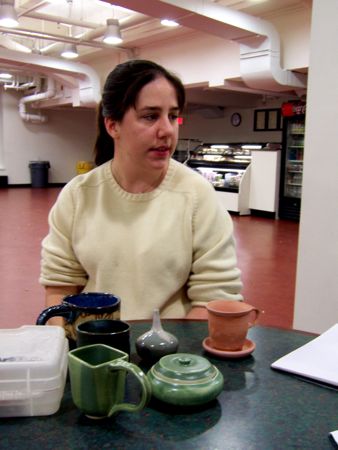
Sara Hoffman with several mugs, a bowl, and a bottle that she has made.
.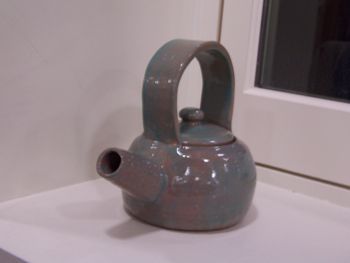
Low-fire redware teapot. It was made through a technique called “throwing on the hump,” which involves placing a large lump of clay on the wheel, shaping the various parts (spout, lid, bowl) of the teapot out of the large lump, and cutting them off as they are formed. The handle was formed from a slab of clay. Water cannot be boiled in the pot, but it is still usable for tea.
 .
.
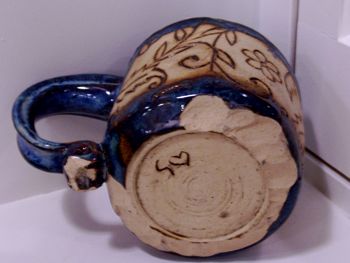
High-fire stoneware “with higher grit” mug with blue glaze; wheel thrown. The mug was rolled over a block with raised designs to create the pattern. The glaze was then applied and wiped off from the center section, so it only remained in the designs. The bottom shows chipping of the glaze and body. The mug was not placed on stilts when it was fired and the glaze stuck to the bottom of the kiln.
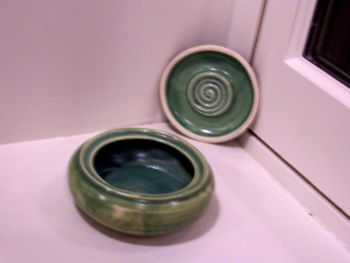
High-fire stoneware bowl and lid with green glaze; wheel thrown using “throwing on the hump” technique. The bowl and lid were thrown at the same time to ensure the same wetness of the clay (and therefore the same amount of shrinkage). However, it is generally very difficult to ensure that the lid will fit, so typically several lids are made for one pot, to increase the likelihood of a usable lid.
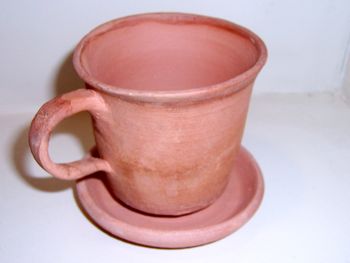
High-fire unglazed redware mug and saucer; wheel thrown. Both the mug and saucer have been fired once (bisque fired), but not yet glazed and fired a final time.
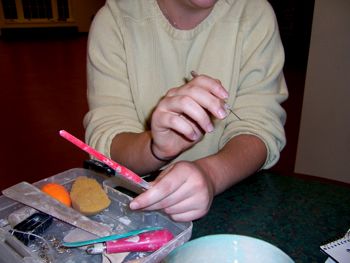
Various tools for working clay. Includes wire cutters, trimming tools, stamp-carving tools that are used for decorating, and a piece of deerskin for smoothing. She is holding a small awl, which she uses for measuring the thickness of the clay.
