Chorus discussants: Ariel Schecter, Harry Aspinwall, Harrison Stark, Alexandra Corrigan, Sarah Baker, Lolly Lim, Alexandria Hartley, Timothy Simonds
Please have provocative comments/questions/discussion points posted by 8 pm Wednesday, March 11!
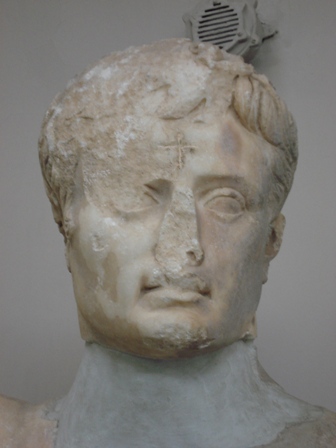
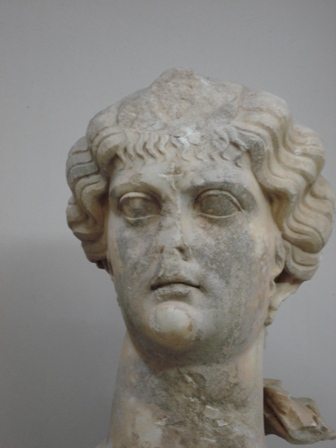
Portrait busts of Augustus and Livia with crosses etched into their foreheads.
(Ephesus Archaeological Museum, Selcuk Turkey)
Sarah Baker:
There was SO much in these readings...thought I'd get the ball rolling with a few points that stuck out to me:
Latour wrote in this introduction that science deserves more than the polarized reactions of worship and disgust. I would like to extend his argument to the other two classes of icons he examines: religious and contemporary art. I'm wondering how societies can move beyond this duality of fetishism (like that described by Meskell concerning the WTC site) and iconoclasm. What other dialogues are available here? Also, and related to that point, I like to discuss whether the actions surrounding the WTC truly voyeuristic or disturbing? Plenty of people seem to think so, but I think it's possible that some of the clinging to materiality is less voyeuristic and more an expression of grief. Materiality allows for quantification and location of grief. It seems that Meskell is suggesting that the American treatment of the WTC site is a form of iconoclasm, adding to the tragedy of the original iconoclastic destruction. I'd like to draw this out and discuss, if possible.
Elsner examined architectural iconoclasm, while the other authors dealt more with image iconoclasm. The case of Tom Quad was especially interesting. Elsner interprets the unfinished cloister as an attack on the monastic lifestyle. However, the bits of the cloister that were built could have been removed, either intentionally by the builders or, later, by some other iconoclastic force. However, a shadow of the cloister remains, and was even imitated later as the building was expanded. This is a really interesting case of architectural palimpsest - it doesn't reflect something which was built and then dismantled, but something that could have been, but was never totally completed or removed. What does this say about the strength of the motivation to erase that part of the plan, or the success of the iconoclastic act?
Finally, I'd like to bring up Meskell's point that monuments are "reminders of the past and harbingers of the future". I know we've talked a lot about history/memory, but future/memory have an equally interesting relationship. One possible purpose of remembering is to motivate action, whether that action is iconoclastic or preservationist. Iconoclasm relates to the future in that iconoclasm can be viewed as 'clearing the way' for the next iteration of images or beliefs - it can be an act that actively rejects the past, in order to promote a certain future. I'm interested in talking more about memory/future in this and other discussions.
alex h: I agree that this topic has a huge encompassing body to it, and the arguments and discussion can go on for days. I find myself centralized around the ideas that Crawford and Elsner talk about when it comes to the act of "forgetting" and "memory" form both authors. Elsners idea of "forgetting" as an "active, purposeful, and collectively performed" is the backdrop to the argument that Sarah Baker brought up about Tom Quad. Whether the palimpsest was because of dismantling, or never completed as stated above, it took activism in that choice no matter what, and the decisions are always purposeful, especially since we are talking about iconoclasm. The choice is there, we just may not always understand or know the reason years later. the main focus in the article was the idea of the visual iconoclasm, and highly proven by the idea of "damnatio memoriae" as we discussed in class on tuesday. It is the idea though that the tell tale marks will always remain behind, more in some cases than others, but they always remain, but do the memories? Elsner also discusses how centuries later under Constantine's rule, the "recarving served not only the negative function of replacing the fallen tyrant-but also the positive purpose of casting the new emperor into the bodies once occupied." the idea that even though you are erasing the memory of the ones before due to tyrant rule, or just re carving for any reason, the memory of the one once there will remain, and was a conscious act to be a part of the past that came before you. The concluding argument in that Elsner has is a great connection to how we, as modern western culture, view the idea of iconoclasm and how our views so recetly have changes significantly than that that stood for centuries. It all revolves around how we view memory, and inevitably art. the connection to memory with prototypes and reality are quite different. So a question is why have we decided to stray away from the ideas of holding prototypoes, pictures, art, and do not view them as highly related to the actual person as they did in the past? We just see an image, and it does not hold the same power it used to. This is directly related to our modern days views of "monumental commemoration."
I found myself most relating tot eh ideas that Crawford brings up in "memory performances" and how they fall into three different groups. I think you cannot classify all things int eh same group, there are different motivations, reactions, desire, and aspirations of accomplishment. These three groups were "collecting and abducting, erasing and defacing, and reinscribing and replacing." collecting i think is self explanatory, the defacing and erasing although is not viewed the same as it was in ancient times, does happen, even in the present modern day world. The example given is the statues being ripped down of Saddam Hussein in Iraq. the message coming form that area, whether damnatio memoriae or modern defacing, these things tend to occur in "highly charged political environments of personal and institutional power struggles? I understand why those would be some serious reasons, but can we think of other things that would make people in modern times do that as well? I feel things were defaced on a more regular basis in teh past, so whynot the present? Is it just that we have more resources to create new ones?
Posted at Mar 11/2009 06:42PM:
Harrison Stark: What fascinates me is the frequency with which we see iconoclasm, and the fundamental ambiguity associated with it. Latour discusses extensively the ambiguous motives behind iconoclasm, even going so far as to categorize iconoclasts into 5 distinct categories. Yet I believe there to be a fundamental paradox to the act of iconoclasm itself, not just in its motives. As Elsner puts it: "the act of iconoclasm - while apparently a kind of visual defacement that effaces the memory of the destroyed - may nonetheless preserve the memory of the condemned in the very act of obliteration" (p. 211). Thus, all iconoclasm is a sort of iconoclash, and Latour's premise may be extended beyond the sometimes ambiguous motives behind the destruction to the destruction itself. In this case, I feel we must address the seemingly simple question - does iconoclasm work? How effective is the defacement, and how do we define that success?
This also begs questions regarding remembering and forgetting. If iconoclasm is seen as an act of forgetting, then the spectacle (or visual trace) of the image's destruction clearly plays a key role. But if this is the case, then 'forgetting' is not really forgetting at all. As Elsner says in regard to a Roman 'damnatio memoriae', "it signals not just that someone's memory has been annihilated but that we must note and remember that the forgotten are forgotten." (p.214). Thus, the act of forgetting is really just a spectacle of public humiliation, and not really a erasure of the social memory at all. This difference between actual forgetting and using visual cues to induce a memory of humiliation brings up questions regarding the difference between a void and a ruin. To what extent are visual cues vital in the erasure of memory? Or, more simply, is the point of iconoclasm to forget, or to remember? Lots to discuss tomorrow, dream team.
Timothy Simonds: Elsner says that the Christian incarnation of the Tom Quad and the Pantheon rearranged "charged spaces" making them a "damnatio memoriae of old ritual through the assertions of new ritual. But the damnatio was also enacted through the potent combination of preserving the architectural spaces in its original arrangement and then specifically altering the focus of behavior within it (225). In most liturgical architecture there is specific "holy" direction that determines the plan of the liturgical environment and the behavior of the practitioners. As Elsner presents the Tom Quad and Pantheon are iconoclasticaly rearranged by the removal of venerated forms; here there is no demolition or visual defacement but rather a behavioral displacement. When the function of an architectural space changes it becomes a different place although it has not changed spatially so to speak. In this instance there is a definite iconoclasitic performance, a defacement and creation of a space; however, should this performance be attributed to those behaving within the space (the students, or the practitioners and priests) or the "renaming" of the space by a figurative administration.
In another performance of iconoclash, the destruction of effigies it is important to note the power of these among many cultures. These are transitory objects. According to John Emigh in Masked Performance transitory objects “help bridge, or effect transits, across gaps in continuity” (Emigh p.2), aiding in or promoting liminal events (7). These objects are first discovered when the child experience long periods of time in the absence of the parent, and “learns to employ “illusion”…or animate qualities” upon an object. From childhood the human instinct uses “imaginative creation and play… when a developing sense of continuity is threatened” (2), staving off “anxiety into modes of activity used to induce pleasure” (3). Such transitional objects are most commonly found in religious events where there is a break in continuity, such as in death with the tau-tau (ancestral effigies) that are left in the Cliffside, overlooking the Tanatoraja culture in Indonesia (8). Ancestral effigies aid a community in marking and bridging the gap in continuity that a death causes; gaining this power by a performance or play with them. While the tau-tau are dressed, set in the hillside and then redressed on other liminal occasions, others are burned and broken; however, for all of them a iconoclastic performance engenders their power.
Posted at Mar 11/2009 08:38PM:
Ariel Schecter:
For me, a central question that arises over the course of these readings is what exactly is attacked or addressed in an act of iconoclasm. I think that our discussion of images on Tuesday was a little bit limited because the traditional boundary between an image and that which it signifies has been blurred over the course of this class. Memories and identities become inscribed in objects, and the defacement of these objects is more complicated than simply destroying a sign- it also implies some sort of direct interaction with the ideas, identities, or memories that are embodied within. The question therefore becomes, as Flood puts it, whether iconoclasm is a declaration of the non-realness or illegitimacy of an object's embodied significance, or whether it is an attempt to deprive the object of the possibility of having significance or legitimacy.
I would like to address a quote from the Crawford reading: "people are well aware of the power of images, and are adept at manipulating and using this power to situate themselves in relation to their pasts" (38). This awareness of the power of images is manifested in those who believe in them, as well as those who oppose them as intrinsically unholy and un-real with respect to meaning. What does this say about the nature of our institutions, ideals, scruples, and beliefs, that the battleground for their legitimation is materialized in the physical world? Do we ever even have access to the raw material of ideals or beliefs? Or is the only way that we are able to work with them for us to externalize them into images, objects, texts, and other means of signification? Do we ever engage with life itself - be it ideals, ideas, beliefs, etc.- or do we simply try to access it through arbitrary signs and images? Surely the answer is complicated, but if signs are so powerful, and if we are so aware of this power and yet we engage and condone it, then are our "meaningful" experiences indirect to a certain degree?
Damnatio Memoriae is also an extremely provocative idea for me. First of all, just the fact that we have evidence of it proves that this type of iconoclasm is also an act of remembering. Especially in those instances where it is clear that some figure was erased from a public work, damnatio memoriae simultaneously acknowledges both the importance and the failure/shame of the person at hand. I think that this dual function is a result of the way that we, as modern archaeologists, have analyzed and understood these relics; the intention of those who made and altered these works is secondary to this discussion since it is entirely conjecture. Is this act, then, of interpreting and analyzing these structures not its own act of iconoclasm? By having this discussion about the implications of the alterations, aren't we adding our own interventions and violations to whatever it is that these works signify? To what degree is interpretation itself always an act of iconoclasm?
Damnatio memoriae also reminds me of Orwell's 1984, in which people are erased and pasts are rewritten at the whim of the government. The people mold themselves and their memories to this newly dictated history instantaneously because they have become so manipulable by the government. Does this bear at all on the reality of how interpretation and reinterpretation, and the general evolution, of critical theory erases and defaces the past? Haven't all images and objects been altered, violated, degraded just by our gaze over time?
--- Alex C: These readings (as the chorus has mentioned above) unpacked a lot of information about iconoclasm, but still left many open ended questions for me. A couple things I thought were interesting: Tim's point about the tom quad was an interesting interpretation into performance memory. I thought this went nicely with Elsner's point about the Protestant's revision of space through the turning of their backs to the East (a traditionally Catholic ritual reversed). I thought Elsner's ponit about special signals signifying a ritual desecration of memory was interesting, and i'd like to read more about these changes in performances. I think the readings did a good job of really examining the spontaneous performance acts as really interesting ties to function, deformation, defacing, reality and conservation, but I'd like to see more examples of these performance memory examples over time. I wanted to ask, when is it helpful for a political historiography to look at violence as defined by iconoclasm, and when is it helpful to define violence as simply violence? And, as I was reading Elsner and ariel's response, i was thinking of questions in the context of realness/total legitimacy and false icons -- and whether this matters, and where the meaning of these icons reside (virtual material tension vs. meaning between function and story). Wwhat potency do these examples gather from giving legitimacy (or "object biographies") to the before-objects, rather than simply attacking their pastiche/frivolity. One thing I think would be good to discuss is a individual memory in context of these iconoclastic acts. Do we really have a sensitivity to the previously existing objects/images before voids were there, as damnatorie moriae suggests? And what process do we enter when understanding a violent act vs. an iconoclastic act? I am interested also in the idea of Vergangenheitsbewaeltigung ("coming to terms with the past") that suggests that our viewership isn't without interpretation, ever. Lastly, this leads into a point I found commonly touched on in each piece: conservation as a critical act. Meskell makes this point, and connects it later to archaeology. She uses an analogy of environmental preservation, which I think is helpful in understanding the "non-renewable-ness" of history. Lafour makes an interesting point about this curation of history, saying that perhaps we have too much of a critical eye and interpretation built into our system of signifiers that has lead to our incredible amount of museums and mausoleums of past objects. Flood speaks of a museum silencing inanimate objects, which brought my questions about the present forward: what relationships do we patronize (with the past and other cultures) through this preservation and display? Do we assert our modernity through preserving the past? Or do we assert it through (as Crawford says) appropriating memory to legitimization/assimilation of current political regimes, falsely revering the past and (perhaps falsely, perhaps not?) equating ourselves and the past. I'm not sure where I am going with this question, but i think iconoclasm's relationship to urban modernity and political uprising is very interesting.
Posted at Mar 12/2009 12:20AM:
Harry:
Something which really stood out to me were the distinctions in the Crawford piece between Collecting and Abducting, Erasing and Defacing, and Reinscribing and Replacing. I found it interesting to think about the altering of monuments in one way or another as a means of gaining individual power. This ties into the Latour piece when he examines the goals of the iconoclasts and the roles of the icon. For Shutruk-Nahhunte and Assurbanipal, the spoils of war could be a method of appropriating a history of power and assimilating it, so that it becomes a symbol of your power. Ownership of and interactivity with the past is of huge importance, like for the Aboriginal practices in the Meskell piece, when they would relate to their past much more directly, by continuing painting in areas ten of thousands of years old. Assimilation of a history, yours or someone else's, gives you that power.
There are two routes to gaining an icon: Make it your own, or destroy it and show your dominance over it. As Elsner says, when you commit destructive iconoclasm, you assert that something which was intended to be remembered forever should now be forgotten. By such an assertion, and by being the agent of destruction, you place yourself at a higher level than that which you destroy, and by extension the belief, devotion, labour, and most importantly power it manifested. The mark of your hand as its destroyer is a mark of dominance.
However, one of the most crucial differences for me is between defacing and destruction of an icon, and its complete obliteration. In many ways the total, traceless deletion of an icon is more serious than simple destruction, because when you destroy, you buy into the game of continually asserted dominance, where one symbol replaces another, even when its a negative symbol replacing a positive one. The mark of the higher power is present. When something is so seriously against what you believe in that you have to remove all mark of it, you sacrifice your own dominance because you sacrifice any mark of yourself. There is no subject or object. Total obliteration is a selfless act, one that doesn't change a period of history, or assimilate it for its own ends, but one that seeks to erase an idea from the face of the earth so that not even Elsner's memorial to forgetting, a disfigured statue, a hacked-out cartouche, remains.
Posted at Mar 12/2009 01:07AM:
lolly: One of the things I found most interesting in these readings about iconoclasm was the revival of the damaged images and their restoration/neutralization. In reference to Buddhist icons which were targeted for destruction, Philippe de Montebello, the director of the Metropolitan Museum of Art in NY stated, “let us remove them so that they are in the context of an art museum, where they are cultural objects, works of art and not cult images” (Flood 651). I was interested in how the identity of an object could be altered just by displacing it from its physical location of controversy. Objects bear the scars of “performances of memories” as Crawford states; an object that was marked for destruction or desecration is especially one full of conflict. It is interesting then that by physically transporting them to a museum, a space designated for nonpartisan engagement, the objects themselves become culturally neutral, a piece of history that is frozen in time, politically neutral, separated from the contention that surrounded it no so long before. They become safe from physical desecration or any alteration at all.
However, by placing them within these museums themselves, the newly “secularized” objects become icons once again, venerated as cultural artifacts within the museum, as objects of historical significance that so narrowly escaped destruction. I found this process of changing an object’s significance from one of contention, secularization to one of veneration interesting.
These readings also got me thinking about a more common but less overt type of iconoclasm--graffiti--and where it would fit in within Latour’s letter scale of iconoclasm. Although all five types of iconoclasm can relate to graffiti, i thought that “b”-- “the people...against freeze-frame, not against images” would be most relevant in that those who mark buildings and other objects with graffiti do so with the purpose of changing that space or object, contributing to it their own input, values, or frustrations. The stagnancy of an object is broken through the inscription of the graffiti, wherein the object becomes an a more fluid space that represents changes, that is in and of itself is change. “The damage done to icons is, to them, always a charitable injunction to redirect their attention towards other, newer, fresher, more sacred images: not to do without image” (Latour 27)
There is also the graffiti known as “tagging” which i believe is a “performance of memory” that can be interpreted as re-inscribing. An artist’s “tag” is his/her signature--it represents him/her as an artist, their skill, their defiance in approaching an existing structure and marking it, representing their dominance over that wall. This reminded me of the inscription of the Stele of Naram Sin in which the Elamite king Shutruk-Nahhunte wrote next to the original Akkadian inscription the brief account of his royal heritage, conquest, and dominance. In this way, he makes his authority clear, while this strength is fortified by the fact that he inscribed it directly next to the original etching. Similarly a tag is placed on a wall that was designed and created by someone else; by spraying their mark on this wall, a graffiti artist attempts to assert their power over that object, and to leave on it part or memory of themselves.
Ariel Schecter:
Some post-discussion thoughts: Iconoclasm is an act that reveals an essential paradox of human art and communication. On one hand, images and symbols are always reductive and unstable, so the act of creating an image or symbol always results in a loss of translation between the abstract idea and its material embodiment. In this sense, images are iconic, destructive, and even sacreligious to some people. On the other hand, images and symbols are the only means that we have of communicating and analyzing our ideas- indeed, one might even argue that symbols (and their relationships to other symbols) are precisely what gives meaning to our abstract ideas or beliefs. The impact of a beautiful poem, inscription, painting, carving, building, or any other work of art testifies to the fact that symbolic representation holds a great deal of power. Is it possible to even draw a distinction between a "pure," abstract idea and its related operational symbols in the physical world?
This rhetorical question, and the underlying contradiction is, for me, the meaning of Latour's iconoclash. In addition to the clash of content, such as religious clash when the Bamiyan Buddhas were destroyed or the cultural clash of renaming Armenian/Turkish cities, there is also the clash of not knowing exactly where our emotions, ideas, and beliefs reside.
I was thinking about what Prof. Harmansah said at the end of class about the small acts of iconoclasm that fill our daily experiences. Grafitti is one example that comes to mind, because it is so pervasive and visible. However, like any act of iconoclasm (or iconoclash), the power of the act comes not from the act itself but from the social response that it generates. The argument against grafitti, first championed by Mayor Giuliani in New York City, is that more serious crimes increase when grafitti is visible because the structures of the state, control, and community property are degraded. This argument implies that the symbolic environment (similar to the milieux de memoire) has the power to shape human behavior. It is fascinating to think that even if the government is constant all along, people's fear of the law will actually change just because itssymbols change. The reality of the government is, in effect, less powerful than the symbols it produces according to Giuliani's theory. This idea reminds me of panopticism, or the disciplinary gaze theory of social power. The subject establishes the government (or any other source of influence, meaning, inspiration, or authority) completely within his or her own mind, according to the government-related symbols that one has perceived over time. If these symbols are affected (tagged with graffiti, for example), then the subject's self-imposed construction of "the government" also changes. Thus, an act of iconoclash serves not only as debate between symbols themselves, but also shapes individual constructs (and therefore the realities) of life forces such as the government, religion, or cultural values.
Posted at Mar 15/2009 10:18PM:
Timothy Simonds: Post discussion:In response to Ariel's first remark above I would like to argue there is something extremely important to acknowledge in the discrepancy (loss in translation) between an image or icon and its referent. First I would like to say that the referent of a representation should not be limited to the tangible. We can find many instances of iconoclastic representations of the intangible, such as emotions or language. Within this gap or slippage between the abstract and the "original" is the heart of its evocative quality. The absence or discrepancy that is being presented asks each individual to view and recreate a personal concept of the "original"; and it is certain that each spectators conceptualization will differ. What arises from this gap is not only visual but emotional and psychological; an emotional aesthetic that will always be understood on some parts while misunderstood or inaccessible on others.
In discussion I was frustrated by our brief mentioning of contemporary art because of our over generalization of it. I myself do not believe most art to be iconoclastic in the manner that we were speaking of it. While there are many instances of citation and re-representation I think it is a mistake to claim that is those authors' intentions are to evoke this. Conceptual art, what I believe was confused for Contemporary art in discussion, is not dependent on citations or a type of self-referencing. In fact in many instances, such as in works of Judd and Lewitt, it may seem that is trying its to escape from doing this. However, does an attempt to escape iconoclasm paradoxically birth iconoclasm?
Reiterated once again, iconoclasm implies a paradox. Maybe it is within this paradoxical nature that it has its power.
Posted at Mar 16/2009 09:31PM:
Lyndsey Barnes: I was trying to formulate this idea in class, but I just couldn't get it out in time! When we were discussing with the Buddhas and what was going to be done to reconstruct them, I was reminded of our early discussions of how to appropriately memorialize things and events such as 9/11. The notion of iconoclasm complicates the memorial process. How can one memorialize the original space? And what happens when something that was destroyed is permanently removed?
Posted at Mar 17/2009 10:44PM:
Lolly Lim: One thing i found interesting during our conversation was the idea of the image of iconoclasm becoming an icon itself, ie) the pictures of the Bamiyan Buddhas falling, video clips of the Twin Towers' collapse, video clips of Saddam statues smashed into bits. The fundamental irony of iconoclasm--that an attempt at the destruction of an object makes that object more powerful--can be seen through the preservation of the act of iconoclasm. This got me thinking about what the ultimate and most successful form of iconoclasm would be. Would that simply be the destruction of the icon, then the destruction of any trace of this performance? Or could we take it even further and say that iconoclasm could entail the banning of the very creation icons in the first place? Would this be considered icono-“ban” and something different from “iconoclasm”?
Icons are created as representations of human ideas, beliefs, and notions of “truth”. If these intangible ideas were never allowed to be manifested into objects, but survived only through spoken words, songs, gestures, and other means without physical embodiments, would this be considered iconoclasm? if yes, would the ultimate purpose of iconoclasm be fulfilled knowing that the ideas, emotions, the “truth” that was meant to be represented in a physical object would still exist in the world, simply in a less tangible medium?
