The second practicum was awesome. We looked at how we might be able to plan the location of a bloomery furnace (or other iron smelting system) to most efficiently reach the resources necessary and most practically lay out the operations themselves. Concerns we discussed, while not as directly resolved as if we had gone out in the field and built a furnace, did lead to a better understanding of what factors go into smelting design. Plus, we did it in an afternoon.
I think that this practicum was also unique in that it focused on the logistics of the solution. Often, while discussing the craft of production and the actual history of these processes, the details of everything but the production is overlooked. As we discussed in class, ore isn't very exciting, while fire is. However, by being forced to consider all the details of the process, from the actual collection of wood to the design of the furnace and which tools we would need to complete the smelting furnace, I've gained a new respect for the people building these devices.
It is pretty daunting imagining going into the wilderness with nothing but a boat, horse, pickaxe, and a boatload of food to try to start up a new iron production facility. Our solution to this was to start as small as possible and make things easy to begin with, followed by a slow transition more reliable materials. To begin with, we hope to use bog ore and a simple charcoal-fueled bloomery furnace as a basic building block to set up a facility. Technologies will slowly be added to this basic framework, such as latent heat hot blast systems or a water wheel bellows.
This set of choices was made because it is simple, so a smelt can get started and we can get resources and materials immediately to continue future operations. We researched the quality of ore in the Adirondacks and found that it has good quality bog ore as well as mineral ore. Thus, we are likely to have quality results in either case.
Next, we focused on how the actual process would play out. In this, it is critical to see how the layout of the ore relates to that of the furnace. We chose a location that was up in the hills so that we could easily add a water wheel, and low enough that there was a bog ore deposit nearby and a large flat area to roast ore on. The process, every day, would go something as follows:
1) Go up in the hills and chop down some trees to build a fire. We need to get trees ready through drying and such, but presumably we will not need as much per day if we get some every day. By being located in the hills, we don't have to carry the heavy logs as far.
2) Use the small boat to cross the river and collect ore, than bring it back. This is relatively easy, since we can cross the river on the boat and the bog ore is literally just across the river from the bloomery location.
3) Break up the ore. Because it is high in phosphorus, being bog ore, the brittle properties will make this easier than if low-P mineral ore were used.
4) Heat up the bloomery. By using charcoal, which is relatively easy to produce from logs using heat and a simple burning process, we can achieve a heat high enough to produce wrought iron but not too hot so that the furnace needs to be fed continuously. With only a handful of us in the woods, alone, it would be daunting to feed a whole blast furnace system by hand. If we can slowly work up to that instead, it becomes achievable without worrying about overwork.
That's the general process, with some food left out of there.
It's all about the logistics, and having the right mindset going in is important if you are going to survive. Bloomery furnaces, even charcoal powered ones, are very difficult to make correctly, and blast furnaces are even harder. Thus, I would say that starting simple is the most important lesson our group learned from this particular practicum.
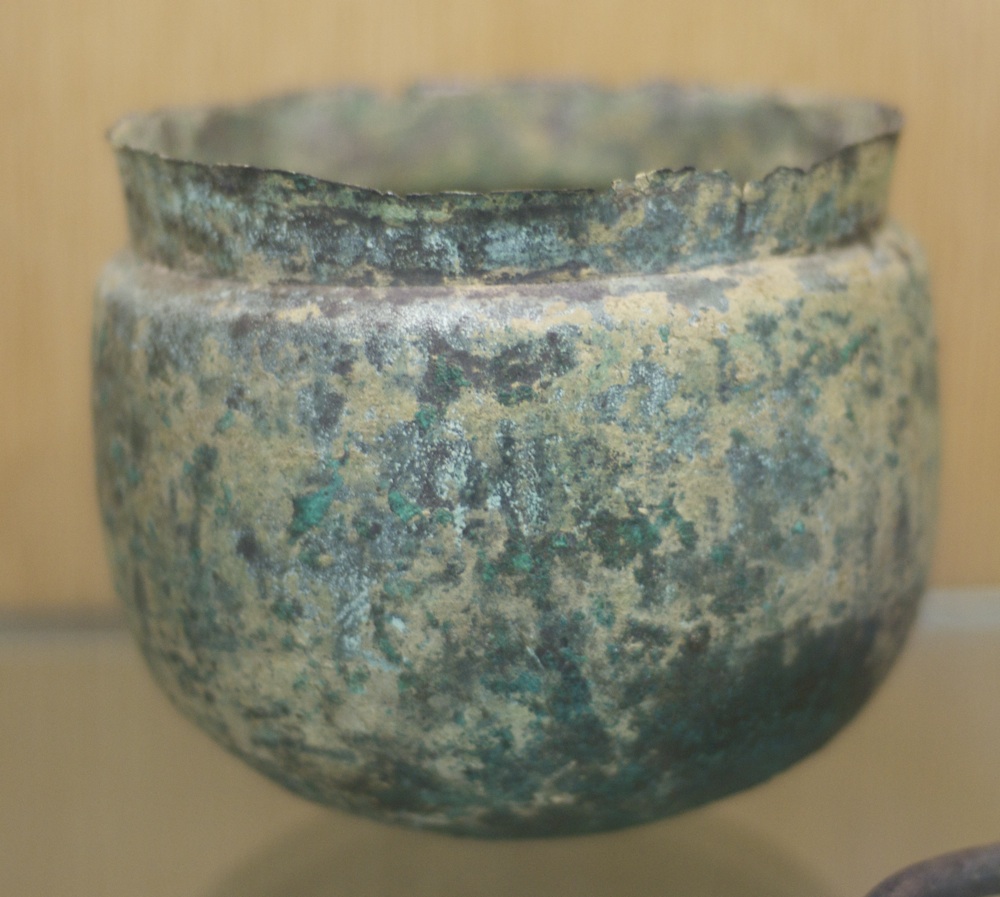
1. The object that I selected is a hammered bronze bowl. It is about 10cm in diameter and 10cm tall with a rounded base. In addition, the upper centimeter and a half are devoted to an inward sloping rim section which flares outwards to form an open rim. It is made of metal, and the combination green and brown patina would lead me to assume it was made of bronze, as these are commonly associated with copper and iron. The preservation state is mixed. On the one hand, it is intact and does not appear to have suffered any major blows after being finished. On the other hand, however, there is a large amount of patina and copper/iron oxide buildup on the surface of the bowl.
2. The object was made presumably using a traditional bronze-working technology. It was later cold-worked with hammering, as evidenced by the small surface indentations and rounded, pressure-formed top edge. Indirectly, the temperature was a key component of the different phases used for the manufacture of the bowl. Given the high quality and thin walls of the bowl, it was made quite well by a capable metal smith. Thus, it is expected that the iron production process, while it could have been smelt based, was probably a well-controlled process.
3. There are quite a few flaws in the construction. Most specifically, the wall at the very top of the rim where the top had not been smoothed off and was left "rough-hewn." This is not necessarily a functional change, however, because it works fine and the irregular edge could very well have been an aesthetic choice. assuming that it was not a purposeful design choice, however, the flaws were essentially caused by the smith figuring that the product was "good enough" for the purpose and so he/she stopped working on it.
4. While the post-formation production process, the formation of the bowl, is rather evident from the inspection, the metal itself and how it was formed is still unanswered. It would be easy to tell the heating processes above the cold working stage by looking at the microstructural properties of the copper and iron components of the metal. This can be achieved by SEM imagery most easily. In addition, the mere compositional information int terms of cupper-iron ratio, which can be obtained using XRF, which gives the bulk composition of the metal.