




Archaeologists know that excavation has side effects and that preservation is a critical component particularly for the architectural integrity of a freestanding precinct like the Petra Great Temple. Since 1993 when our excavations began, every year, our fundamental aim has been to consolidate, restore and preserve endangered portions of the Petra Great Temple precinct—most often those areas affected by excavation.
Together with the Jordanian Department of Antiquities, each year we critically examine the assessment of particular needs. A stirring debate brings about a consensus—in effect this becomes a collective effort exploring priorities and developing smarter, safer more efficient schemes to inhibit the progression of structural damage. Based on the quality of the plans the collaborators decide on the best choices and create a trusted solution for the Great Temple annual preservation plan—a most comprehensive tool to improve existent architectural integrity of the site. Additionally, a financial plan is prepared, and we obtain assistance from experts in related fields, and survey each project as an informed collective.
October 2005 is the first instance we have presented our preservation measures on this Web Page to raise the public awareness of our activities and to foster an academic forum for dialogue on the conservation issues impacting the remains. As we look to the year ahead, we are in the process of writing a comprehensive evaluation of the annual projects we have undertaken for the final report. The following is a summary of only the 2004-2005 activities.
Restoration and consolidation efforts have been under the supervision of Dakhilallah Qublan and have included numerous projects including the re-erection of the Propylaeum columns and the pointing of walls. Dakhilallah has the technical skills and hands-on experience needed to launch these projects. Between excavation seasons he spends six to eight months with a professional staff carefully consolidating the site. These renewal restoration measures are monitored while treatment is in progress, and reports are issued to all the parties involved. The impressive Great Temple archaeological site is rich in diversity as well as complexity. Not only does it require a compendium of knowledge and experience for its immediate preservation, but it also demands an understanding of the side effects that could occur and options that can be put into effect.
Propylaeum
This first project addressed the immediate relevance of the Propylaeum columns to the complex as a whole. The link between the temple and the major monuments of the precinct cannot be viewed from the street, and the re-erection of the columns contributes to the public exposure of the site.
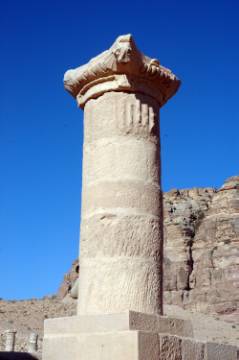
Propylaeum Column, partially
restored in 2004-2005
Propylaeum East Room 3
In the Propylaeum East the in situ vault was consolidated and restored. At the end of the 2004 season there was is danger of its collapse that was a distinct possibility. The arch itself had 108 new blocks added. The interior wall measures 3.20m in height-by-5.70m in length. Fifty new blocks were added to the east wall and 37 new bocks were added to the west wall. The ledge under the arch was 5.70m in length and 11 new blocks were added to complete this ledge. For the top of the arch measuring 4.00m east west-by-4.60m north south, 65 new blocks were added. For the rear wall 86 new blocks were added, and it measures 5.40m in length-by-1.30m in height-by-1.25m. This compelling project took several months to complete.
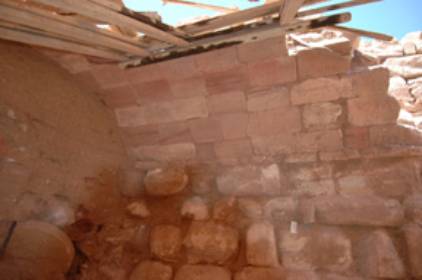
Propylaeum Room 3 Vault before Restoration
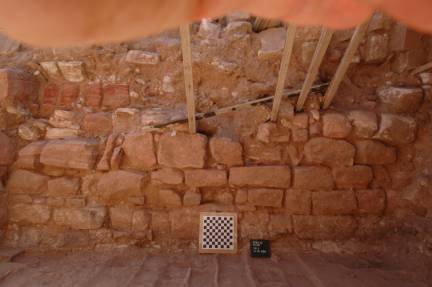
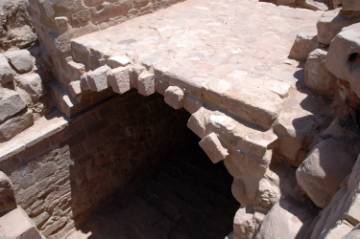
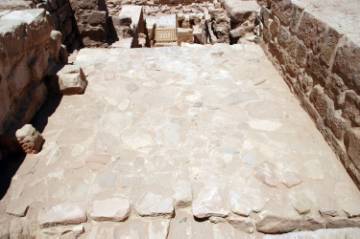
Above,
Propylaeum East Room 3, Arch; Bottom Roof Over the Arch Restoration
Lower Temenos West Cryptoportici
One of our guiding principles has been the immediate emphasis on the pointing of walls. Once an area has been excavated the walls which inherently are endangered and at risk of slumping have to be stabilized. In some cases this work helps prevent symptoms of deterioration before they start. Often the work entails the repair and replacement of ashlar blocks for the stabilization of the structure. The replacement blocks are taken from our site lapidary storage and are retooled for restoration. Painted lines indicate the blocks that have been restored, so it is clear what was excavated and that which has been restored.
The Lower Temenos West Cryptoportici walls needed to be pointed for their stabilization. It was 26.00m in length-by-3.50m in height. In the west wall, 36 new blocks and 42 pieces were reconstructed between arches. As for the east wall, 11 new blocks were added and 38 blocks were reconstructed between the arches. The two east and west arches from the 2004 excavations have been reconstructed.
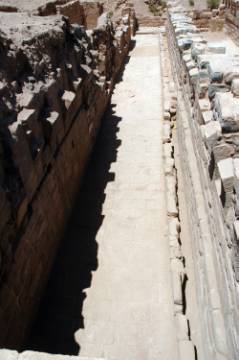
Lower Temenos Retaining Wall
The east west Lower Temenos Retaining Wall emphasizes the primary importance of the Lower Temenos as an integral element of the Great Temple precinct.
The consolidation and reconstruction of the Lower Temenos Retaining Wall, located to either side and in front of the Central Staircase was aimed to establish continuity between the east and west sides of the wall, the absent portions of the stringcourse and reverse cornice band were reconstructed in the west. The goal of restoration in this area of the temple is threefold: (1) to stabilize the highly disarticulated fill of the Lower Temenos Retaining Wall and the damaged Central Staircase, (2) to build up a barrier to prevent the collapse of fill onto the Lower Temenos, and (3) to present scholars, tourists and other visitors to the site with a more complete view of the temple’s façade—and provide a realistic appearance of the original Nabataean construction.
The Lower Temenos East West Retaining Wall measured 12.00m in length-by-1.05m in height. Only on the west under the reverse cornice 15 new blocks, 0.20 m in height, were added. The cornice as restored is 12.00m in length and 22 new blocks were carved and implemented the existing reverse cornice. In the wall construction, the added blocks were 0.25m in height (to indicate they were added, these are smaller than the original blocks). Four courses of ashlars were added; to the west side (east): 26 new blocks to the front, 79 new blocks; to the west, and 105 new blocks and to the east wall east: 12 new blocks were added. Added to the front east were 86 new blocks and to the west were 89 new blocks.
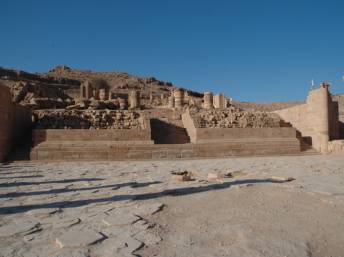
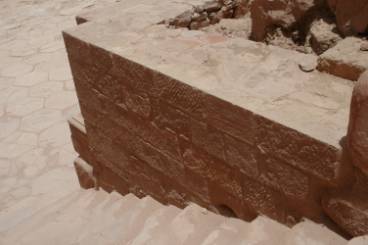
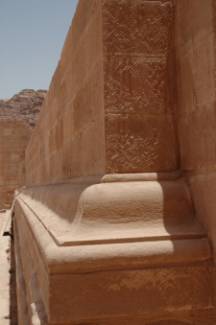
West Corner of the Lower Temenos East West Retaining Wall
The West Corridor Frescos
Since they were excavated in 1998, plans for the protection of the West Corridor frescos are still in progress to tackle the root causes of disintegration. For several years we have been actively involved in the protection of the extant fresco fragments.
In 2004-2005 the important frescoes in the temple West Corridor were again stabilized and protected against water run off with an unobtrusive slope on the top of the shared West Corridor-West Walkway wall to deflect the winter rains.
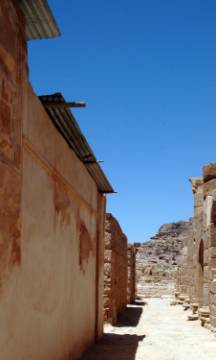
West Corridor First Steps taken to protect the Frescoes
Areas of Misuse
Effective policies had to be developed to inhibit the use of hidden sectors of the site as refuse or waste collection areas. Some sort of protection had to be put into place for their integrity. Our placement of barriers helped us sustain the intrinsic values of the site that had been humiliated by disrespectful visitors.
Excavated areas of the precinct—the Residential Quarter, the Baroque Room and the East Propylaeum Rooms 1-3 —have been used for litter by visitors. Entrance to these rooms has been discouraged by the insertion of doors or grills barring access to them.
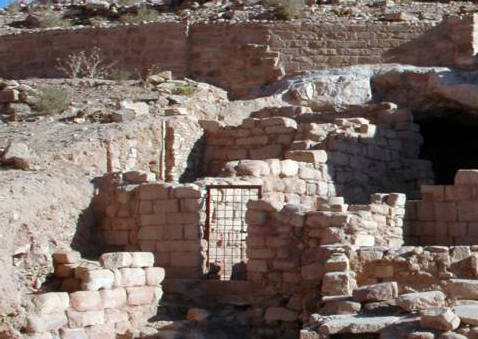
Gate placed at the entry
to the Residential Quarter
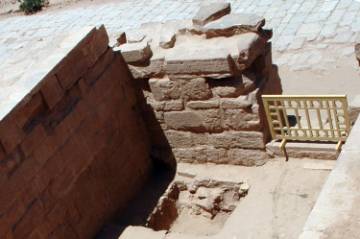
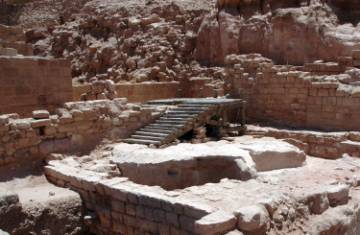
Stairs constructed with Turkish Railroad ties to provide access between the South Passageway and the West Plaza of the Upper Temenos Providing Public Access
The construction of stairs indicates to site visitors the importance of a flow pattern from one part of the site to the other. At the time these stairs were implemented there was no access from the west Upper Temenos to the South Corridor. A flight of stairs from one side of the west wall to the west plaza complemented the flow of traffic.
Wood planks from Turkish railroad ties 2.00m-by-2.00m in size were provided by the Jordanian Department of Antiquities. East of the West Wall is now composed of 10 steps and west of the West Wall are 12 steps providing passage. Now the site can be safely visited and accessed from one area to another.
Artifacts
Artifacts compose the visible promise of a site and issues of their conservation and preservation depend on their material and their structural integrity. Each type of object poses a new challenge for us. We hope we have fostered effective strategies in dealing with artifacts of different materials.
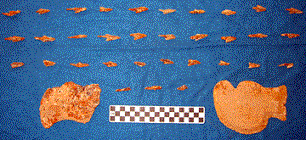
As for the metal artifacts, including the coins have been sent to Amman to be restored at the American Center of Oriental Research, after which they have been documented for the site database and ultimately returned to the Petra Museum.
Archaeologists must be responsible for the artifacts they excavate. Besides the special finds turned over to the Jordanian Department of Antiquities, there are three on-site storage areas at the Petra Great Temple, and in 2004 the reorganization of our artifact storage was undertaken so that we would be able to find useful elements to be used for consolidation or reconstruction.
In storage Area #1 are located small decorative architectural elements—vines, hibiscus blossoms, pinecones, poppies, acanthus leaves, elephant head components as well as other capital architectural fragments. There are over 5637 numbered and registered stone artifacts stored here along with marble revetment pieces that have, in effect, been returned to their micro environment.
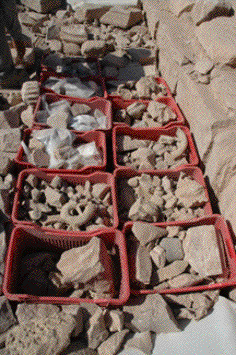
Petra
Great Temple Storage Area #1
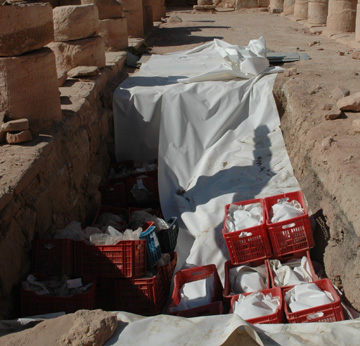
Petra Great Temple Storage Area #2
Storage Area #2 contains the majority of excavated pottery diagnostics as well as plaster, metal, and bone objects. Here are located 107 crates; 91 boxes of pottery, 12 boxes of stucco, 2 boxes of bones, one crate of soil samples, and one crate of glass. This storage provides researchers access to our finds.
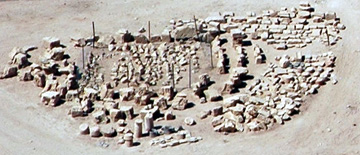
Storage Area #3: "The Great Temple Sculpture Garden"
To the southwest of the site, west of the most west West Wall is what we call our sculpture garden comprised of large sculptural elements such as capitals and pilaster blocks. Here there are approximately 150 architectural fragments arranged in rows with the most delicately carved smaller elements behind a centrally fenced area.
Concluding Remarks
These comprehensive measures are crucial to the structural integrity of the Great Temple. The importance of preserving and conserving this great precinct and its artifacts cannot be underestimated.
We brought Petra’s large-scale Great Temple to life. That is something we are proud to be part of, and we are committed to protect our shared cultural heritage. The wide significance of the Great Temple has challenged and inspired those of us who have worked on it and beyond. We know the strength and experience of our preservation and restoration vision can help secure the Great Temple’s future generations of researchers.
To be successful our challenging preservation program requires resources, personnel and money. If you are interested in helping in this endeavor, please send us your contribution to the Brown University, Great Temple Preservation, Box 1921, Brown University, Providence RI 02912, USA.